
Wednesday, 16 April 2008

CLOSE ENCOUNTER OF AN UNKNOWN KIND...


What actually happened that day in County Powys in South Wales may well remain a subject for debate, but it was all eerily unreal, and the details remain unexplained to this day. The unnerving part of this recollection is, that everything is based on the facts of that day and my very own experience of them.


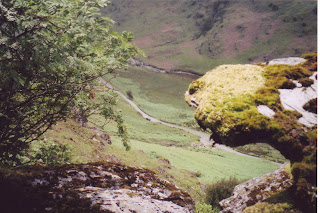
I occasionally, on a spontaneous impulse, take a drive up on the M4 and across the Severn Bridge, past Tintern Abbey into the heart of Breconshire, or just beyond into County Powys. The Welsh National Park in the vicinity of Tregaron, just across from the great Elan Valley, is where I usually secret my car and grab my binoculars. You can hear the bleating of sheep and the raucous konk of carrion crows. On sunny July days, I may roam the hillsides, foraging for blueberries, or be watching the superb circles of the Red Kite. There’s not a day without the ubiquitous rooks on the rocky crevices abandoning themselves to the balmy caresses of a glorious upward drift, nor without the solitary sky-lark rising in ascending circles.


And at night there is an intensity of stars....

It’s like my idea of fairyland. A dreamy, soulful, poetic landscape with windswept clouds over green valleys. And that day was magical. For the sedentary townie, physical exhaustion is the rarest of experiences. For me it’s central to the pleasure. Accordingly, I was trekking across the high moors, in a great, sweeping detour, skirting cairns and forging brooks, when, at some point in the fading light of the late afternoon, something quite extraordinary happened. I stumbled across a giant boulder of a rock, the size perhaps of a ten-ton truck - freshly disturbed in the soil.

There it stood, silent, dark, and unfathomable, brooding dully in the long shadows of the fading afternoon.
I was greatly mystified in not being able to find any tracks in the soft ground, even though the blessed thing had been violently stirred in the mossy earth. No human could have exerted that kind of force. No animal, not horse nor elephant. There were no footprints and no tire tracks.


And yet, the rock had moved.


That was the haunting part. That and the feeling which emanated from it.I stood mute with doubt and incomprehension. The disturbance was no more than a few hours old, at best, and County Powys is not known for its earthquakes. Suddenly I found myself wishing I had not had come. The air was motionless. The silence so intense it seemed to invade my mind. In fact, I began to feel incredibly alone. Truth to tell, at this point I was beginning to worry about lots of things, but I was also getting the feeling that I was being watched. Wisely, perhaps, I turned and walked away.

And that might have been the end of it.

If my experience of hiking has taught me anything, it is this: Never lose your means of survival. I always take precautions. Without fail. Imagine my surprise, then, when all of a sudden I became aware of the fact that my keys had vanished. The entire bundle. Car keys and all. Lock, stock and barrel. How did this happen? I would now be stranded on a totally moonless night in a lonely, rock-encrusted valley of the Welsh National Park.

One of the strangest of all synchronicities then occurred - was this real. I still ponder on it. Once again, that mystic feeling was present. I almost seemed to be in a trance, it was as if I had switched over to the unconscious. It may sound extravagant or even melodramatic, but I felt I was dreaming with my eyes open. Regardless of diminishing visibility I remembered every stalk I'd ever stepped on, every pebble, every twig, every boulder, every ledge, like the pages of a cryptograph - to use an bizarre analogy. It was touch and go, a wing and a prayer - until, in one of those so strange and still so inexplicable effects, I stumbled across it, like a needle in a haystack: my bundle of keys, tidily secreted in the long, coarse grass.

Contact with my vehicle was resumed at 10 pm local time on a Friday, in the pitch darkness of a moonless night, eight hours after departure. Locals say there is a ghostly presence encamped on the slopes of the Brecon Beacons, watching with eternal vigilance over their terrain. And I’m not sure I want to go there. But all our acts have consequences. And if the universe has engineered, not just its own awareness, but its own comprehension, where does coincidence end and personal synchronicity begin?

Thus, my close encounter of an unknown kind began and ended in a mythical space, a garden of ambiguity. And my only option was to shrug my shoulders and to admit that certainty had no future here...


Dreamy


Monday, 14 April 2008

RICHARD’S DILEMMA


"The local University runs a creative writing course," says Richard Madeley in his latest bulletin. “I’m tempted to apply for it.”

All my life, I’ve been the idealist type, believing that the driving force of literature is essentially one of inspiration. I rather thought that you had to have a devouring passion for writing, as others have for gambling (after all, the odds are the same).

But perhaps I am simply out of touch.

There are, apparently, alternative ways to learn how to write: one is to sit in a creative writing bubble and live in a time warp - a region whose boundary shrinks to zero if you have nothing else to add - and the other is to set off at a blistering pace, hoping one’s temporal lobes don’t shear off under the sheer thrust of adrenalin. Which is like landing and take-off at the edge of a precipice. Way to go. A kind of literary re-enactment of downfall and salvation, involving a season in hell and a vision of death and rebirth. But it’s the torments of catharsis rather than hours spent with S & W’s Elements of Style that reveal the inner life (even though I’ve always been trying my best to view it as a challenge). Of course, you can always go to the public library and take out The Complete Idiot’s Guide to Writing Fiction. The inspired sense of the art of the possible which has characterized all the greatest literary movements - the sanguine, the melancholy, the choleric and the phlegmatic - then becomes the limited longing for the literal lust of the language. No thought could be further removed from the notion of catharsis, but it helps to be artless. It could make your fortune.

So here I am, attempting to present myself as an inspiring muse while commiserating on my own experience as an accomplished failure. Alice reckons that if I keep climbing the pole at the
Spearmint Rhino, I’d sooner or later catch the eye of a nifty and resourceful fixer calling himself a literary agent. That’s typical of people who are all about instant gratification. Alice, of course is the protagonist of my latest book, and has opinions as to the pros and cons of literary procedure that no amount of logic can dispel. Quite unlike Richard Madeley who, much like myself, is at heart a humorist, and who very kindly suggested that I should start this blog. That took me by surprise. I doubted anyone was interested. But if I were to return a well-intended piece of advice, that would be to look beyond the agents of today to the agents of tomorrow. You are, commercially speaking, strategically placed, and literary internment is not a desirable condition. Nor is staggering aimlessly around the literary circuit in search of representation, with little more than creative writing seminars or workshops on synopses as your literary heritage.


"Don't loaf and invite inspiration.
"Light out after it with a club." -

Jack London

Thursday, 10 April 2008

THE LARK ASCENDING...


“Listen Sweety,” Alice said - she says this frequently - “let me read you something from this wonderful book:
‘There is one dimension common to us all,’” she mouthed the words delicately, “‘a dimension which all humans, without exception, may enter and leave at their leisure. This dimension is called hope. Precious as life itself, this hope is our redemption and it is entirely up to us to preserve it untarnished by doubt or anxiety. Nurse it as you would the apple of your eye.’


Isn’t that beautiful?” She heaved visibly

“Beautiful?” I said. “I repudiate it with contempt. Fool’s gold, if you want to know. More innocent than obtuse, but no less irritating. No substance and all glitter. Any suggestion of entering or leaving the realm of hope at your leisure is simply grotesque. When the world comes crashing down on you, and you are peering into the dwindling prism of the last ray of light reaching you down through dust and rubble, that’s your final court of appeal, honey. Hope is what you cling to, like a pinprick in the sky.”

“Gosh.” Alice said.

“Nursing it as the apple of your eye is not my idea of hope.” I was working myself into a frenzy. “Nor are silly books about nothing that people read habitually and without apparent discomfort.”


“Sheesh.” Alice said.

“Sounds suspiciously like the purple patch of a twenty-something saccharine, cloud-hopping poet,” I was out of limits.

“Of an octogenarian Rabbi, actually.” Alice came back peevishly.

End of conversation. She saw no reason to be emollient. I felt singularly unmoved.

So how about you, folks?

Hope is not about mental, nor physical, preference. As I have found many times in my own life, hope is the most vital life force after hunger. Hope is religion in its most profound and mysterious sense; and nobody knows that better than God himself. Hope is...


.. the thing with feathers,
That perches in the soul
And sings the tune--
without the words,
And never stops at all ...


It’s got to be - because every time I look at this verse, my tears are welling up - thanks to Emily Dickinson who, by all accounts, was a tall, bony, American spinster, with an unhappy life and a difficult character. And thanks, too, to the immensely enlightened person whose name presently escapes me, but who posted this verse for Nige on Bryan Appleyard’s excellent blog - (to which I am unable to link or access at the moment of this posting, since it appears to have crashed).

All is not lost though, there’s HOPE!


Dreamy

Monday, 7 April 2008

PERFIDIOUS ALBION - THE INCONVENIENT TRUTH


# 1 In Britain, one in five children - 2.2m - now live in households entirely dependent on state benefits
# 2 About one in eight children in Britain are growing up in homes with parents who are alcohol abusers or habitual drug users.
# 3 More than 20 children and teenagers are being treated in hospital every day for alcohol-related, and/or mental disorders
# 4 600 children under the age of 10 have been charged with serious offences in 2006.
# 5 The number of those under 18 found guilty of possessing an offensive weapon rose by 82%, from 648 in 1997 to 1,181 in 2004.
# 6 The number of prescriptions for anti-depressants hit a record high of more than 31 million in England in 2006
# 7 Britons drink 11 litres of pure alcohol a head each year, the equivalent of 28 bottles of vodka
# 8 One in five adults in Britain is "functionally illiterate",
# 9 Four out of ten Britons suffer from some sort of personality disorder.
# 10 There are 1.55 million untaxed vehicles in Britain.
# 11 Three out of four untaxed vehicles are used by people involved in some other criminal activity
# 12 In the 12 months to March 2007 police recorded 89,200 robberies,
#13 Britain has the highest prison population in Europe
# 14 Britain also has 4.2m public CCTV cameras, or one for every 14 people, and 8,000 automatic number-plate recognition devices
# 15 In 2004 more than 150,000 cases of harassment were reported to the police nationwide. (A 26% increase on the previous year).
# 16 One in four nurses has been attacked at work.
# 17 The number of patients in British hospitals dying from superbug infections has reached more than 10,000 per annum.
# 18 England is about to be the most overcrowded European nation. Ready to overtake Holland, leaving only the tiny island of Malta with a higher population density


No sentiment is more firmly rooted in the English national character than a distrust of foreigners. And for decades, at every socio-economic level, whites have fled their incoming non-white neighbours. People who lack a sense of community put up fences thinking they are living in safety, when actually they are living in a prison of fear, having succeeded merely in swapping one form of captivity for another. For while the indigenous birth-rate continues to fall, ethnic figures steadily increase, making them an integral and irreversible part of Britain’s racial structure. The result has been communities segregated by race, religion and culture. And here perhaps lies the real danger to the liberties of England: an increasingly divisive population among whom animosity to Albion is a sacred creed.

Once having been the arbiters of nations, grounded in a profound sense of what it meant to be homo britannicus, now but an appendage of a centralising European super-state, Britain has met the full force of an inherent schizophrenia in her domestic culture. And the statistics you’ve seen above are nothing, if not reflective of the dejected spirit of a people once infected with ideas of conquest and exploration, now marked out for the moment of their final humiliation.

Not unlike the Viking conquests, this moment will remain sculpted in the history of the moral, political and social regeneration of perfidious Albion. This migration will bury the old England, together with its civilization as it existed to date, and England will never be England again, or I am much mistaken.

Dreamy


Immigration - The Inconvenient Truth. Tonight on Channel 4, at 8 p.m.

Friday, 4 April 2008

THE AGONY OF AFRICA...


To redeem the past and to transform every ‘it was’ into an ‘I
wanted it thus!’ - that alone I call redemption!
Nietzsche, Zarathustra


Africa’s agony is far from over!

And while it is hardly an extreme position for an African statesman - such as Mugabe - to take, that it is legitimate for Africa to preserve her identity as a black continent, I am, personally, deeply disturbed by this development. And not least because it indicates a catastrophic discontinuity in what was clearly a subversion of a natural Darwinian law:

That of successive historical evolution!

It is, I believe, a mistake to say that Englishmen had a contemptuous attitude to the proprieties of global colonization. If global colonization was an Anglo-Saxon idea which might appear sinister to post-colonial minds, it was also part of the cut-and-thrust of historical evolution. And within the limits imposed by mans inhumanity to man the British Empire was well enough executed in welding over five-hundred million disparate peoples into something like a commonwealth of nations. It meant as much to have extended the frontiers of western genius, than those, indeed, of its empires. In fact, it is the peculiar distinction of England to have bequeathed a constitutional ethic which, today, covers almost the entire globe.

Moral hindsight, by contrast, is the cheapest intellectual function available to posterity.

This may seem curiously heretical, but it is worth remarking that the result of the vastly premature emancipation of sub-Saharan Africa resulted in economic disaster and human tragedy on a colossal scale. The abolition of slavery in 1834 was perhaps the greatest civilizing culmination in human history. But the sudden colonial independence movement that had its inception some six decades ago, has in fact destroyed Africa’s commercial agriculture and turned a continent which should export food to the entire world into a basket case whose main export are destitute political immigrants.

This reversal is unique in human history!

It is also based on a moral misapprehension. Upon a distortion of the terms nations use in their Declarations of Independence. Moreover, I also find that, if not legally invalid, it is in fact illegal under the Articles of International Law, that it should be more important for justice to be seen to be done than to be in any sense effective. For that is not just bad or wrong - it is deceitfully, historically disastrous. It would be an omission to describe it as anything else. In a matter of decades, three-hundred years of European settlement in Africa came to an end as tens of thousands of settlers abandoned their holdings. The Empire was closed down, on the politically correct grounds that it was considered ‘predatory’ or worse, an ‘anachronism‘. The most presumptuous part of this exercise was the presentation of Africans themselves in the role of builders and reformers, the legislators and indigenous organiser, who perceived in their freedom not just the salvation of Africa and the black race, but the basis for a great new confederate Pan-African dispensation.

I, too, admire freedom and I believe in equity. And that the most abhorrent and devastatingly exploitative of all European acts of aggression were perpetrated against Africans, I would not even attempt to deny. But what is truly abhorrent and devastating about this freedom, is that African history not only ground to a halt but started juddering backwards. The once impressive communications infrastructure left behind by the European colonisers has been allowed to fall into almost total disrepair. It is virtually impossible to believe that Western politicians ever tolerated, much less condoned such a reversal. Instead of redeeming their empires, by creating a true commonwealth of independent nations, these spineless rascals rendered tens of millions of people dependent upon UN handhouts, and - in an irony not to be surpassed - had the temerity to apologised for past injuries, while adding insult to new-fangled ones.

We no longer have an industry to talk about,” said Callisto Jokonya, the head of the Confederation of Zimbabwe Industries. “We have de-industrialised ourselves." The enormous problem of self-determination remained only partly answered with the eviction of the white man. It was too early, at least by fifty or a hundred years, even to talk of setting up purely native states as part of the process of political emancipation. It simply led to massacre, loss of freedom and greater tyrannies than those that preceded them. Fraud was rampant. Political office an invitation to plunder! Once the most affluent country in Africa, Zimbabwe now has the world's lowest life expectancy's. Leprosy and malaria are back and flourishing, along with the new kid on the block, Aids. The streets with their Mandela statues and fading colonial mansions are being reclaimed by vegetation. Once-fertile fields now lie scorched or weed-ridden. Steam trains are being re-commissioned, and ambulances are being pulled by donkeys.

Some African countries were so far from being qualified , in fact, to govern themselves, that any such efforts did little to alter the fundamentally tribal character of the hunter-gatherer communities. The conflict in the Democratic Republic of Congo, which is hugely rich in mineral resources, to this very day still exacts a monthly tally of some 45,000 lives. Indeed, we can argue about numbers, but it remains indisputable nevertheless that the murderous number of contemporary deaths in Africa is by far surpassing the levels of colonial casualties under Imperial stewardship. It may seem lacking in a sense of discretion to mention these two projects in the same breath, and yet it is amply justified, because in terms of self-inflicted African casualties there simply is no comparison.

With roadblocks made of skulls and human intestines, Africa’s physical degradation is complete. The philanthropic view of the African as a converted native is metaphorically striking, but untruthful. His belligerent tribal nature seems hard-wired, unchanged and unchangeable. Survival requires exceptional cunning, shrewdness, and a complete lack of moral scruples. Above all her catharsis is incomplete. Part of her destiny ended up in the hands of infant soldiers who became notorious for murder, rape and hacking off limbs. What’s more, a million children are dying from malnutrition. Truth to tell, children are fighting children in guerrilla wars that are entering the third decade. Rwanda’s genocide, at its peak claimed 8,000 lives a day, a rate faster than the Holocaust. Governmental forces invariably are either incompetent or implicated in the very casualties that are compounding the sectarian conflicts. And so the genocide grinds on, with no chance of victory.

But if victory is impossible and peace unimaginable, where can Africa go?

Far from having given leave to Africa, The Empire, today, stands at the receiving end of the intercontinental migration from poor to rich countries that is comparable in scale only to the great resettlement of the classical past. As the Romans themselves found out, democratic engagement with the world became an inescapable cause of their own demise. Roman identity had always been plagued by a sense of her own adulteration, and if the Babel of foreign languages in her public places, was bound to cause demographic apprehension as well as considerable cosmopolitan pride - then, Europe today, must assume the same swagger at her peril.

Dreamy

Tuesday, 1 April 2008

MY HOROSCOPE FOR ROBERT GABRIEL MUGABE...


Horoscope for Robert Gabriel Mugabe. President of Zimbabwe. Born February 21.1924:


Once the breadbasket of sub-Saharan Africa, Zimbabwe has experienced an economic and humanitarian melt-down of unprecedented proportions.

And since late February, when the belligerent Mars moved into the most reflective angle of your chart, you, Robert Gabriel Mugabe, have been reviewing how past political directives and concerns have ensnared you and those who plead allegiance to your cause. Indeed, this will be the eighth consecutive year of food shortages since you launched your ill-fated programme of seizing white-owned farms. Part of this was pure terror. In fact, terror has been your principal weapon.

But as Jupiter, the planet of truth and mystery is presently involved, you are forced to address the consequences.

It is a moment devoted to the ecstasy of iconoclasm, the demolition of all kinds of authoritarian hope, a time for discarding old beliefs and ushering in new ones. And if anyone tells you this time will be easy, don't believe them. Indeed, you will be plagued by the visible presence, not of spirits, but of demons from African mythological pre-history, who will show themselves in a thousand different guises, compromising your own political exit and forcing you to recommit to those solutions that are still available.

While voters have been driven away with tear-gas and batons, the World Food Programme has been distributing food aid to more than 1.5m people, nearly 10% of the population. But in the end they will be left with nothing. No obstacles, no standards, no values, no sense of continuity with the past or purpose for the future. And one night when the moon is blood - subsequently to be known as The Night of the Long Knives - rampaging mobs throughout Zimbabwe will attack Zanu-Pf affiliates in the streets, in their homes, and at their places of work. Dozens of your party cronies will be bludgeoned to death and hundreds more maimed; more than a thousand homes will be burned; almost as many businesses ransacked, cemeteries and government offices vandalized, and thousands arrested, sent to detention camps, or put before international human rights tribunals...

And with that in mind, Robert Gabriel Mugabe, when it is time to resolve whether you ought to stay in government or leave office, you should have no problem in making up your mind.

(Miss Dreamy’s astrological analyses are spontaneous and available to members of national governments worldwide).

Monday, 31 March 2008

Death is the first condition of renewal...


Behold the good and just!

Whom do they hate most?

Him who breaketh up their tables of values,

The breaker, the law-breaker:


He, however, is the creator.

Wednesday, 26 March 2008

...a most extraordinary conclusion!

... God Etc


“Christianity may not be generally necessary for science but it was certainly necessary for the emergence of science in our culture.”

This statement is interesting, not just because it is from the ever irrepressible blogger Bryan Appleyard, but because it would seem as if the Gods themselves were protective of this unseeing man. And considering that the biggest threat to the emergence of science came from within his religion, it is also, by any measure, a most extraordinary conclusion.

It is true, Islam had a tendency to gain converts through violence, whereas Christianity proceeded in the intimate and academic confines of the medieval monastery. But even at my most insane, I would not for one moment refute, that it was Islamic and Arabic culture which kept alive the philosophy of Aristotle through the Dark Ages. If anything, Islam was the religion of reason - Christianity, a trinity inspired by the cult of art. Mathematics and medical science were developed in the Islamic world. And - just for the sake of being encyclopaedic - it is here where the Sumerian, Babylonian and Assyrian cultures flourished, which gave us the wheel, writing and arithmetic. The fact that there was any scientific progress at all within Christianity, says a great deal for the persistence and devotion of men such as Bruno, Galileo, Descartes, Copernicus and many others who intrinsically opposed it - but it was fundamentally the influence of the Greek philosophers, whose work provided the bedrock of the Renaissance, which replaced religion with logic.

Nor did Pythagoras only teach his disciples to abstain from eating animals.

Two and a half thousand years ago, Anaximander, Pythagoras, Anaxagoras and, most importantly, Archimedes and Euclid took the surviving legacies from what was known of Babylonian and Egyptian culture and began the process of quantifying, calculating and evaluating them. Euclid's Elements, was the primary source of geometric reasoning throughout Western history, at least until the advent of non-Euclidean geometry and irrational numbers, in the nineteenth century. Scientists of the Huxley-Darwin era who proclaimed the existence of a body of knowledge based on observable facts, too, were a deep embarrassment to the Christian Church. And to tell the whole truth, centuries of discrimination masked the extent of the Jewish contribution. In the second half of the 20th century, Jews received 29% of all Nobel prizes. Among the most famous recipients were Albert Einstein, the physicist and Milton Friedman, the economist.

My point, gentlemen, essentially is that so far as science and religion are concerned, they are merely two different ways of striving for the same deliverance. Today we are excited about scientific advances, notably in the fields of neuroscience, genetics and nanotechnology. But even when leaving aside the question of whether it is possible to reduce all of nature’s complexity into one single strand of causality, anyone who is capable of following a still more transfigurative hope, will also be able to see the unification of physics not only as a scientific discipline in the reductionist sense, but precisely in its cultural context as an evolved form of gnosis.

The result, therefore, is not a lack of belief in God but a lack of belief in a “religious” God.

Certainly in the sense that there is little real discrepancy and practically no incompatibility between the visionary and the scientist who are surely indivisible in the whole nature of our perception of space and time as some kind of inward and outward unity. Indeed, the most significant feature of The Theory of Everything is the new answers it aims to give to the ancient problems of ontology. And I, personally, would strongly suggest that it represents something like a synthesis of science, philosophy, and the world-view it aims to transcend, and that it may, together with that other great conceptual accomplishment in theoretical physics, the quantum theory, even offer us the supreme contemplative achievement of modern civilization in the West.

Its spirit is profoundly religious!

Melancholy, inward looking and austere, orthodox Christianity is, by contradistinction, little more than an accretion of cultural norms. It simply cannot exist in an ideological vacuum. It has nothing to offer but history. It is no longer a religion. It is an institutional ailment. And this constitutes the tragic greatness and, at the same time, the greatest weakness of Western culture. There is no future to its dogma. For it is precisely from its future expectations, that derives the force and beauty of a species.

Dreamy

Sunday, 23 March 2008

SYNCHRONICITY...


There are certain things one never forgets.


I remember a walk on London’s Hampstead Heath, a long, long time ago. As most of you probably know, the Heath is a rather magnificent, very spacious park in North-West London. Situated between Golders Green, Hampstead proper, and Highgate’s tolling bells, it represents a nostalgic past - a past in which villages were intimately linked to their landscape. And I used to go jogging there for many years while I was living in Parliament Hill.

On this particular walk, Elizabeth and I were admiring the trees in Kenwood. In fact, I have always been enraptured by the view of weeping willows reflected in translucent ponds, by magnificent copper-beeches, rhododendrons, tall chestnuts, or sloping lawns bursting with bluebells. I should explain at this point that there was one particular tree, a venerable oak, I had long been in the habit of passing on my daily jaunts. Feeling exhilarated, I now suggested that we should touch the bark, feel its texture, press our cheeks to the roughness of the crust and close our eyes. Sense the pulse, as it were. It was a heightened form of self-consciousness, a moment of physical exuberance. A euphoric convergence, if you like...

And this is what happened next. As we opened the Sunday papers, two or three days later, we both caught our breaths. There was a feature about flora on Hampstead Heath. And the central pages of the Colour Supplement showed a photograph of a copse of three trees, with our oak prominently displayed in the middle.


I have rarely felt so effervescent about anything!

It is possible to disagree with the cause but there was no arguing with the effect. And even though, it is hard sometimes to separate wishes from conclusions, I could not help feeling that our share in the manifestation was part of the impenetrable mystery. You might say I am more attracted to strange phenomena, than to the ultimate problems of physics and philosophy. But I am convinced that each of us is a participant in creating our reality. As a matter of fact, I felt more than a little responsible for it. I felt like a time traveller having gone back and relived my past. Gone back to a secret area of the soul which, when kept pure, can act as a magnet and draw to itself any event - even an unconscious one. By all means, call it a coincidence, but do not attempt to put the odds in numbers. There may well be half a million trees on Hampstead Heath.


A classical measurement is, as a general rule, an irreversible process. Nor can we grasp the concept of consciousness because it is in terms of consciousness that everything is defined. Each definition merely yields probabilities concerning the next one. But life is not linear, life is lateral. So imagine an amalgam of perception, purpose, desire, and intuition, with a thousand possible contingencies, and you will have a notion of the very intelligent agency which does not fall within the competence of the professional scientist, but which I do not feel able to define any better than by referring to it as “Synchronicity”.

Which fact will give you the key to my entire esoteric constitution. And while I recognize the necessity for a basis of consensual reality, true authenticity, in my opinion, lies in a reality that is part of the personal experience.

It may, on the other hand, mean absolutely nothing.

And I shall, therefore, take the mitigating view that such a synchronicity is only a personal representation of the universe, or a segmented part of it, and that events which relate coincidences to personal observations, are properly speaking accidents only.

Still, the imponderables are enormous.


Happy Easter.


Dreamy

Friday, 21 March 2008

A LYING RETREAT...

My recent visits to the internet were not only a highly gratifying and worthwhile experience, but of considerable therapeutic significance. You see, I had no replies to my advertisement for a young man willing to be eaten, but five e-mails instead, three of which claimed to be incensed. Four really, but one of them was masquerading as a sales promotion for Alka-Seltzer and that new neurotransmitter miracle pill for writer’s block (All drugs shipped via overnight delivery). And if there is anyone else out there who remotely identifies with the same syndrome, I think I may have found the treatment: Sex in the afternoon.

Absolutely no doctor’s appointment needed.

A further e-mail came all the way from Australia, which I didn’t even know was part of the world-wide-web. I know that China is. But then, China is not nearly as well known for its crocodile hunting techniques, is it? Do they have literary agents down-under? I hope not! Not the likes of Mr W***** anyway. You won’t recognize him. He’s not a chef, but a well-known literary fixer who suggested - after I’d treated him to an excellent lunch at Loch Fyne - that I have single-handedly brought the art of bad writing to the greatest height of perfection. Did I mention that he also considered me unsuitable to be ever effectively merchandised.

I often have lunch in Fulham, usually at Lock Fyne, because, as you may known, I love fish. But that’s pretty much the most derogatory thing an agent can say about his potential client. It was not so much his inability to recognise what the public wants, which I found so irritating, as his sheer determination to convince me that he’d never read a manuscript he wouldn't have preferred. In fact, he described my MS as the most unusual he had seen in twenty-four years in the literary business and eleven working as a theatrical impresario.

Sheesh!

My policy, fortunately, is to believe nothing at all said by an agent, with a particular suspicion set aside for those inclined to bolt for the men’s room when you’re calling for the check. Did you know that ‘A Lying Retreat’ is an anagram of ‘Literary Agent’? Well, I didn’t, but it could have been worse, according to my friend Alice, he could have signed me up.

I confess to being relieved that he did not!

The plain truth is, that I am the twenty-first century’s least celebrated and most misunderstood female philosopher, and should ever a literary agent come to determine that he’s on the same intellectual level with me, it will be purely by accident.


Miss Moonshine

Wednesday, 19 March 2008

MY NEW MOUSE...


Today I cleaned my mouse. You know, as you do.

I held it under the bathroom faucet and scrubbed it thoroughly. Dirty little mouse! I subsequently applied the hairdryer to it - lovingly, like you would with a proper furry mouse, and - having put it to every possible purpose except the one for which it was intended - proceeded to pluck it back into my PC.

The next thing I knew, my mouse was dead! The effect had been such that it all but lost the will to function.


So, in the failing light of the late afternoon, I drove all the way past Oakwood to the nearest PC-World, and acquired a new one. This one has a red light under its belly, and it is called “Optical Mouse.“ Everything about it is perfect. And so obedient. It even has a little wheel, topside unfortunately. Though I would lay a considerable wager that it has a secret purpose. And just so I won't look a fool when next dining with Bill Gates, I proceeded to study the Microsoft Product Guide about getting the mouse started - though, quite frankly, I found it a good deal harder even than the insufferable wretchedness of reading Joyce’s Ulysses.


Product guides are the work of the devil!


The man in PC World was extremely charming. He strongly advised me never to bathe my mouse. But never once was he judgemental of my idiosyncratic behaviour. If he was, he pretended not to. Nor was he in any way insinuating that nothing was worth the grief of having to deal with the likes of me. Though he did mention that females were very special creatures.

“I see,“ I said. Not seeing at all!

The customer next to me put his glasses on. I think he liked my cleavage. I have no problem with that.

Poor dead mouse!

I should get over this. But I can't help but think that luck has many faces - and some of them ugly.


Dreamy

Sunday, 16 March 2008

CANNIBALISM...!

The phenomenon that is Spam has always seemed a strange business to me. There has never been a shortage of wacky ideas. But, the way I look at it, trawling through e-mail keeps me abreast of weird things on the web. I read everything. There are websites that explain how not to pay your television license and others, more charmingly, which tell about dildos, ball-bearings, penis extensions, how to commit suicide and the availability of teenage virgins. Not that there is a lot of competition in the last category.


I should know, I used to be one.


Though I must confess that, in all honesty, I am presently searching the internet for a young man willing to be eaten. Culinary cannibalism, as you may or may not know, is now completely mainstream, much in vogue among wealthy young men with nothing better to do. More of a male than a female thing, apparently. Significantly, though feminists have long regarded women as men’s victims, Herr Armin Meiwes, the famous German cannibal, claimed he was never much drawn to dining on females. I know, for many of you, that's a disappointment, though, astonishingly, hundreds of men volunteered when he advertised for a suitable subject. Including, if I’ve got this right, Dennis Nielsen, the necrophiliac from Muswell Hill, who was convicted of six murders in the early 1980s.


My best friend Alice, too, seems to have toyed with the idea. When shopping for men, she says, avoid the urge to bite them. Which seems kind of Freudian to me. Indeed, it may seem rather extraordinary, but what we once considered acts of suicidal mutilation have now become a culinary lifestyle choice. One can sympathise, of course. There appears to have been no specific legislation in Germany governing the act of cannibalism. It is very worrying. But it's not an ethical question. Male genitals served with horseradish cream rather than Dijon mayonnaise, apparently make a remarkably lively dish, and even though dining on other people’s body parts is a freaky concept, once the toes are cooked to perfection, they are, I’m told, a delicatessen to the true hominis connoisseur.


Gunther von Hagen’s Body World tour drew millions to savour his ’plastinated’ corpses. You may well have seen it. Though it can’t have been much fun for Professor Hagen and his entourage, it’s been profitable. Which is precisely why the London Science Museum is planning to introduce a new salacious exhibit to its controversial adults-only wing: a decomposing human body in a glass box. These things can cause a lot of excitement. Besides, cannibalism is not on the list of seven sins drawn up by Pope Gregory the Great in the 6th century. So if you are serious about the enterprise do some research. And I am not making this up. The internet Cannibal Cafe is a cosy, very lunchy sort of place full of cognoscenti with its relaxed gourmet style cachet and its smart feel of young trendies eschewing McDonald’s as a natural life-style choice. And although I love to eat out anywhere from New York, London, Paris to Rome or Mumbai, I haven't yet found anything to match that kind of repertoire. Though, obviously, only those with strong stomachs are recommended to come here. And if you have a large rear-end, a big chest or a prominent belly, make sure not to take part other than from the neck up (there have been claims by New Guinea cannibals that the brain is not good to eat) and include plenty of fruit and vegetables to provide anti-oxidant vitamins.


Bon appetit...


Mademoiselle Dreamy

Thursday, 13 March 2008

LORD ADAIR TURNER = A Study in Schizophrenia


"Office workers should be allowed to shed their suits and ties and adopt lightweight informal clothing to help cut carbon dioxide emissions, according to Lord Adair Turner, the new climate czar."


The media must have wondered if Lord Turner was a buffoon and if this was a jest. His Lordship, apparently, believes that the convention of men in suits and women in smart skirts, is directly responsible for an increased demand for air-conditioning and, according to seasonal requirements, encourages “light sleeveless summer clothes.”

And I suppose it is okay to wear g-strings as long as you're tanned.

The Global Warming show is now an international contest, much like the Booker prize (though without any of its literacy), in which the aim, apparently, is to be the biggest buffoon. It's like an alternative, ecological boy-scout competition. There are a dozen varieties of global saviours, and representatives from every ecological youth gang and gardening show in the world. And there is always another one of those gimmicks that makes you kick yourself for not having thought of it first. Like the issue of ties. For Lord Adair also believes a closed collar unduly raises people’s temperature.


“I do think in the summer we should stop wearing ties.”

It is all that the most virulent green campaigners could possibly have wished for. Here ambitious politicians can indulge their leaning for competence, their need for change and also their intellectual and moral cowardice by ranting about low-energy light bulbs rather than the need for drastic demographic devolution. In fact, the self-perpetuating rant about wind-turbines on motorways, solar panels to heat swimming pools, and civil servants’ personal dress-code needn't detain us.


“We have installed solar panels to heat the swimming pool at our country home “

There you have it. Chairing the new Climate Change Committee did not alter Lord Adair’s way of life. Indeed, these are the people who will brazenly predict a cut in emissions “by at least 60% and possibly as much as 90% by 2050.“ At first with studied certainty, subsequently, as the unforgiving years go by, with ever more desperate self-deception. And those who need an additional sedative can always persuaded themselves that one day carbon trading will make an end of the whole global warming sham.

Another illusion for the undoing of mankind!

Some forms of idiocy are circumstantial perhaps, but considerable nevertheless. In fact, political schizophrenia towards global warming is never more apparent than in the tendency of national governments to offer bigger tax incentives for larger families, while at the same time paying lip service to UN inducements for reducing the world’s populations. When all is said and done, though, family tax incentives are the origin of the problem, not the basis for a solution. For whatever the truth of global warming, this isn’t about taxes on cars or low-energy light-bulbs, it’s about the fundamentally synonymous roles of economic growth and demographic escalation. Precisely because growth and productivity are linked to the volume of consumer population, the only answer to long-term economic decline, is more humans and plenty of them. The headcount, in other words, is fundamental to economic expansion. And the future, never so much as today, is in the hands of monetary requirements.


The fact of the matter is, that random population growth impacts directly on everything, including the invasion of a personal boundary and the denial of primary needs, while attempts to encourage a mature debate about rising population levels are almost universally met with ever more desperate self-deception. No one mentions estimates of potential demographic growth, figures describing the world’s economic ability to support a hypothetical 25 billion by the end of the century, infrastructure and housing requirements, or energy calculations. How exactly is the world economy going to defray a demographic behemoth like runaway humanity?

The simple truth of the matter is that as the world grows, so does the cost of running it. And carbon reduction without demographic cutback is nothing if not a staggering falsehood!

Dreamy

Monday, 10 March 2008

ON POETRY - Simon Armitage's 9/11

“Am I more of a poet than a man of prose? “


That is the question I was asked very recently. Nor, having observed the questioner’s efforts with interest, was I in a position to answer it - except in very general terms. Poetry is prose on the wing - a paean to the transcendence of the human spirit and the beauty of the human thought. The Germans put all their poetry into their music. The Anglo-Saxons put their music into their poetry. The Africans put poetry into their voices. But post-modern poetry, even under the spell of individual eloquence, is bereft of harmonic contemplation. This is the age of the common man, an age of violence, not of poets, and anyone doing verse today, should be prepared, in my humble, untrained opinion, to do it for his own blog rather than municipal masturbation.

Which, incidentally, also holds true for modern art.

Modern art is God’s personal joke on the greedily rich who are compelled to vie for the latest artistic conception in such places as New York, Paris, London and Tokyo. But then, perhaps, I am not qualified to deny the world her versifiers. The Romantic age of Byron, Keats and Sir Walter Scott, opened the notion of poetry to me, rather than Dylan Thomas or Ezra Pound, as did the purple of ancient ballades with their lasting refrains, from Francois Villon to the likes of Baudelaire and Verlaine, or the German romantic movement, Schlegel and Novalis, sooner than the Communist poet Berthold Brecht.

To prove my point, and for what it is worth, here is the link to a Poem for 9/11, Simon Armitage’s 878-line “elegy”, to provide an example of what I have in mind. Read it at your own peril:


Out of the Blue

All lost.
All lost in the dust.
Lost in the fall and the crush and the dark.
Now all coming back.

I’m afraid, as a non-specialist in poetry-processing, what I see are monotonous one-dimensional rhymes, lacking in the ability to radiate charisma, the type of construct that pasty-faced male geeks sometimes send in to local papers:

Then a thump or a thud
But a Pepsi Max jumps out of its cup,
and a filing cabinet spews its lunch.

...and predictable imagery:

The cables, wires, pipes and ducts,
The veins and fibres and nerves and guts
exposed and loose.

Nor did I find the deep emotion and the cry of anguish, that touch of tragic agony, in any of these “limericks.” Above all, I miss the craftsman. This is the natter of an overactive mind, rather than of true vocation. The sort of poetry it is easy to say no to; weighed down with placement stereotypes, inert and passive, rather than impassioned.

Municipal establishments that are also forced to endure the office of Poet Laureate (albeit that this one is still “in waiting”), very obviously, are no longer considering art as a two-way process but as a clash between public ambition and personal aberration. Arthur Schopenhauer said, a “married philosopher” is a contradiction of terms, and so, in my opinion is an itinerant poetaster or “writer in residence” who is exempt, apparently, from public flogging. The very prototype of the window-licking special needs geek. I expect this is his flagship poetry used for spiritual showing off, semi-official auditioning and the loveless beguilement of paid office-holders. Somehow, the pain other people experience becomes pain he has elevated to a personal poetic possession. How terminally desperate would a versifier have to be before he got round to invading the privacy of a broken heart with this sort of trash. To me this is the most stultifying poetry outside junior high. A dullness so intense that it is almost a physical ache. There are parts of verse where you have to say “Shut up, shut up!!” out loud.

here is a calendar, counting the days.
Here is a photograph snug in is frame,

this is my wife on her wedding day,
here is a twist of her English hair.

Here is a picture in purple paint:
two powder-paint towers, heading for space.


I was told of a visiting American relative who refused to read it, on the grounds that it made him want to throw up. How can anyone accept this as poetry, when in fact it looks to me like the very antithesis of it. Every skyscraper in Manhattan is now some sort of symbol for the annual pilgrimage of poet acolytes who come for the pretext of personal sacrifice and pixie propitiation that are the new poetic testament. So 9/11 has long since become a public sore invariably stereotyped by the repetitive pictures of pleading flames swaying brightly against the blackness of the human heart. But it’s only if you really care about something that you can get sufficiently infuriated when soulless zombies disparage it.

Let me be very clear here, lyric aridity is an attribute which defines its possessor's soullessness. Instead of creating a poem, this man created a void.


Dreamy

Thursday, 6 March 2008

RELIGION - FAITH OR FALLACY?

Jonathan: I am talking about higher shades and modes of consciousness and feeling extending up to what has been known as 'God'

My own life, in a way, has been shaped by each of these shades and modes. Nor do I believe in agendas, systems, saints or apostles. They are a cultural no less than a manufactured phenomenon. Above all I don’t subscribe to salvation or eternal life in any religious sense. Those are strategies of a theological kind evolved, in my opinion, as a moral means of shoring up against universal uncertainty. Religion is, in substance, little more than an acceptance of cultural norms. It simply cannot exist in an ideological vacuum. Hence, there is no freedom to its dogma. It merely fosters the theological differences that tend to crystallize into conflicting social priorities and religious wars.

Bretwalda: In the end, all philosophy is speculation but a living faith provides the proof which is not apparent to those who intellectualize the cosmos.

Nor do I make any judgements about Christ. It is my own belief that his birth was sufficient joy onto itself. In comparison to the immeasurable certainties of scientific experience and cosmological perception, such a detail can hardly be considered either universal or eternal. It is true, he made statements about God in much the same manner as one would about a scientific absolute. Nor do I disagree. It just awes me that his belief was so consummate. To put matters bluntly, all it really meant for him was that from the moment you learn to walk on water, you are no longer under the necessity of getting your feet wet. And on the basis of this ascertainable fact I find much in his faith which is powerful and much which is imputable.


Andrew: The human mind is inextricably entwined in the fabric of being; this immense truth reflected in the New Testament: "Before Abraham was, I Am."

The New Testament is, indeed, testimony to the psychological susceptibility of circumstances to faith. It’s an illustration of Christ’s utter self-belief: He knows his place in the universe; it is assured, as He is. Nothing will take that away. Nor do I believe that Christ was attributing to himself unreasonable abilities. If anything, he was a master-craftsman, the redeemer of faith and circumstances. Albeit that not Christ, but the principle of faith itself, is at the heart of the matter. Faith alone operates as a law of selection. Its limits are determined less by God than by doubt. It is equally manifest in Judaism, Islam, Buddhism, the Hindu Vedas, occultism and tribal superstition and reflects in no way on the nature of God other than that it confirms its own selective principle.

Jonathan: This idea that the universe is shaped by our minds seems like a return to a pre-heliocentric cosmology, which put the earth at the center of the universe.

This is perfectly accurate. Except, of course, that it isn’t! Science is the most powerful form of “faith.” And as such, it can mutate the universe. Believing in something can make it true. Its limits are determined less by knowledge than by doubt. Cosmology for the theoretical physicist may appear to have become a study of spatial relations, but consciousness is no longer an observational means external to different bodies in space-time, but a conceptual property of space-time itself. And that distinction is fundamental. The laws of physics may describe the real world, but they are not reality itself. Perhaps we need to be reminded that the principle of physical uncertainty is at the basis of reality, and that certainty is a fallacy. Or that the laws of physics have been formulated by human observation, not of the “thing itself,” but of the world we observe. And remember that, in a homocentric universe, human conception always triumphs. It is a “faith” of great power and creativity. Man is a bystander but also a participant, if not The Creator.


Do I find it viable that God exists? I can find no evidence to support the notion that He does not.


Dreamy

Monday, 3 March 2008

SCIENCE OR FAITH? - A Tribute to Stephen Hawking*


“I saw eternity the other night, like a great ring of pure and endless light...”

Henry Vaughan’s Silex Scintillans was published in 1650. This was the century of John Locke and Christopher Wren. Spinoza’s rationalism established his credentials. Rembrandt painted The Anatomy Lesson and Galileo had seen the denunciation of his controversial Dialogue in 1632. It was a daunting piece of evidence, and this time it would be personal.

Confusion reigned...

Reading Vaughan’s immortal line, I had an emotion that the stars are our timekeepers. That their claim on our attention is profound and enduring. As far back as we venture to do, in the history of the great civilizations, they have always played a central role in human affairs. And what amazing improbably universes, what profoundly dissimilar orders of existence, what different and thoughtful perspectives may be attributed to the same genius and imagination, to the same powers of analysis and judgement at different phases of men’s humanistic evolution. From concepts of faith that began as extremely base doctrines, as amalgams of witchcraft, sorcery and pre-medieval superstitions, to the Theory of Everything which still dominates the research programmes and main funding of theoretical physicists. The latter being the one perhaps supreme contemplative achievement of the West, derived as it is from a sphere of sublime introspection where the cultures of three millennia and five continents hold their symposium; the other from a jungle far below the depths plumbed by the basest superstitious instincts, from an underworld where demons rise from a brewed-up stench of petty-superstitions, monastic latrines and the inquisitioner’s noose.

And I marvel that so scrupulous an adherence to knowledge and causality was able to redeem such an amalgam of chance and circumstance - such a riot of waves and particles, of gamma rays, x-rays, ultra-violet, visible light, infra-red luminosity, microwaves, and radiowaves etc. Things, after all, are visible, or indeed audible, only because of the way that their wavelength interacts with the retina’s threshold - or, respectively, the fluid within the ear - for perceptible vision and sound. Another way of putting this is to say that consciousness is a term used to describe the properties of the object that are essential to 'the thing' being 'it'. And that again is a term which more properly dwells in the realm of morals and meanings rather than in those of ascertainable fact.

Not hues, tones, shades, tints, blushes or dyes, then, but sensations in the cerebellum! Not sounds, but frequency in the electromagnetic radiation. Physical symptoms, in other words, that only arise from mental processes. To me, this is an illustration of our own Divinity, of a growing sense of immortality, of the view, indeed, championed already by Galileo that the act of observation creates the entire universe, that “tastes, odours, colours, and so on are no more than mere names so far as the object in which we locate them are concerned, and that they reside only in consciousness.” Or what Spinoza called in "the effecting cause of the existence of things.”

So, if Man and the Universe are self-evidently the cause and effect of one another, then why make a religion out of a plain and simple fact?
*
Dreamy
*
* Stephen Hawking - Master of the Universe. Tonight, 9pm. Monday 3 March. Channel 4.

Saturday, 1 March 2008

CAUSE AND EFFECT!

bretwalda edwin-higham: I'm seriously not trying to be funny but what exactly is erectile dysfunction? You mean it won't go up?

Elberry: An angry German Feminist once told me that every time a man looks at a woman he's oppressing her. Not 'every time a man looks at porn' or even 'every time a man looks at an image of a woman' but 'every time a man looks at a woman'

Imagine the scene:


There he is, ensconced with a diehard feminist, sharing a romantic dinner for two. He’s recovered from watching her eat stag's testicles, and decided that downing all that tequila could have happen to anyone. He’s reluctantly discovered that she brought her own handcuffs, a change of knickers and two tubes of sexual lubricant. He never permitted himself to stare at her cleavage because of what a German Feminist has explained to him about the deeply chauvinistic nature of the ‘male pornographic gaze'. Eventually, as he sips his brandy, he pops the sweetest question that you he possibly conceive of: "Tell me what you think, darling,” he purrs, “do you think the Earth is at the centre of the universe?"

She slams down her Tequila and says without hesitation: "In an infinite universe, every point can be regarded as the centre, because every point has an infinite number of stars in either direction. Now are you going to get the bill, or am I?"

When the female challenges male authority the result is stress!

Stress causes all sorts of hormones and adrenaline to run amok around the body, which may cause the blood vessels to constrict. That, in turn, can instigate malnutrition of the male member, and starve it of adrenalin. He’s no longer sure how to gain the required altitude. His phallus has all the feel and texture of having been in the deepfreeze all evening. It seems brittle and stone-cold. It is a stiff whose death he’s hesitating to announce. A libidinous coup de grace. Absolutely moribund!

Of course, what she should have said, tilting her head in soft contemplation, is this: "Why don't we go out into the night, my sweet, and take a look at the stars?"

An effect is the measure of its cause!


Dreamy